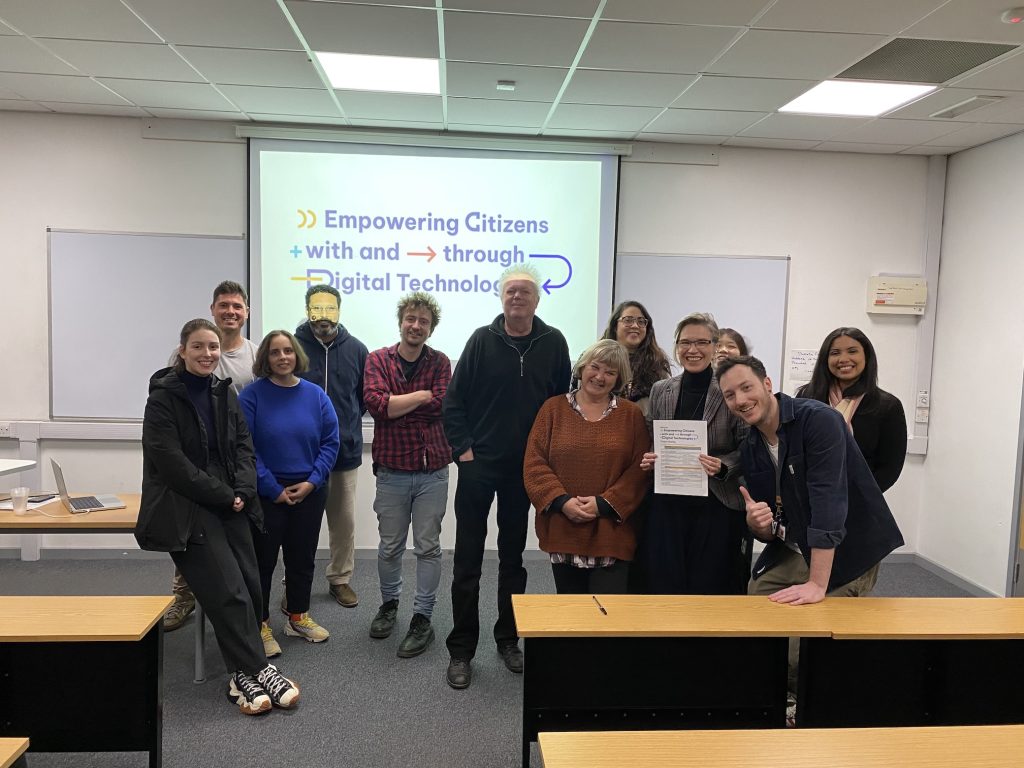
The DCitizens project recently concluded it’s final lab retreat in Newcastle, UK from November 19 to 20, 2025. This lab retreat corresponded to the DCitizens wrap-up consortium meeting, and it was co-located with the Early Stage Researcher training. Moreover, it featured two invited presentations from community partners that commissioned research projects: Aga Khan Foundation and O Dom Maior. The retreat was hosted by Northumbria University at the Computer and Information Sciences school.
Consortium Meeting
The meeting started with an opening presentation from Kyle Montague and Hugo Nicolau with an introduction of the DCitizens project to all participants and a progress report. The second session of the consortium meeting was dedicated to review project KIPs, deliverables, and major achievements. The third session focused on preparing for the review meeting and advisory board meeting. The partners discussed the format of the final report as well as one of the major outputs of the project: the Research & Innovation Agenda for Lisbon.
The day finished with an insightful discussion with Rui Estrela from Aga Khan Foundation about one of the commissioned projects in DCitizens (Balcão do Bairro), reflecting on what went well, current challenges, and plans beyond the lifetime of DCitizens.
In the second day, the consortium was focused on discussing future research collaborations, particularly in identifying potential funding calls within UK and EU. The session included Matt Baillie Smith (Dean of Research Culture at Northumbria University).
Early Stage Researcher Training
Early Stage Researchers (ESRs) were invited to participate in four session. Pam Briggs and Shaun Lawson ran a two-hour session of a 3-minute thesis that helped ESRs distill complex ideas into clear, accessible messages within a strict time limit, which is essential for conferences, elevator pitches, and public engagement. It was followed by a group discussion, which provided opportunities build connections within the project and dive deeper into each others’ work.
In the afternoon, Markus Rohde facilitated a method swap session where each ESR described a research method of their choice. The session exposed ESRs to methodological diversity beyond their own specialisation, expanding their method’s toolkit, while aiming to inspire new ways of thinking about research problems and potential hybrid methodologies.
The second day started with a reading group around science communication and how to approach the design-development dilemma. In the afternoon, ESR engaged in a showcase session by presenting posters and demonstrations of their research.
Community Partners Presentation
The final session was dedicated to two presentation from community partners. In collaboration with Hugo Nicolau, Rui Estrela (Aga Khan Foundation) and Paulo Rosa (O Dom Maior) presented their commissioned projects and major achievements.
Paulo Rosa delivered an engaging and inspiring presentation about WearAccess, a Bespoke Accessibility Service for a Teenager with Multiple Disabilities. In this project, we co-created an always available smartwatch accessibility service that enables access to everyday communication and entertainment applications to a teenager with visual, motor, and speed disabilities.
The session ended with Rui Estrela presenting Balcão do Bairro, a community-based walk-in service desk in Lisbon, designed to improve access to digital services by assisting those who struggle with using digital platforms. The service works as an intermediary or “middle-out” institution, positioned between grass-roots efforts and institutional hierarchies. DCitizens co-created a web platform (https://balcao.dcitizens.eu/) and a series of online tools to collaboratively creating instructional materials, organising events, mapping community initiatives, and collecting/analysing qualitative data about the service impact in its community.